Research
Research
We integrate field and quantitative approaches to understand the social and ecological drivers of risk and resilience in fisheries.
Our approach
Combining empirical and theoretical approaches is a powerful way to tackle questions in basic and applied ecology. Our work sits at the interface of quantitative ecology, population dynamics, life-history theory, risk assessment, spatial ecology, human dimensions, and environmental policy.
We work alongside Indigenous partners and government researchers to produce evidence that bridges science and policy, supporting management frameworks that advance reconciliation, respect Indigenous sovereignty, and promote resilient ecosystems.
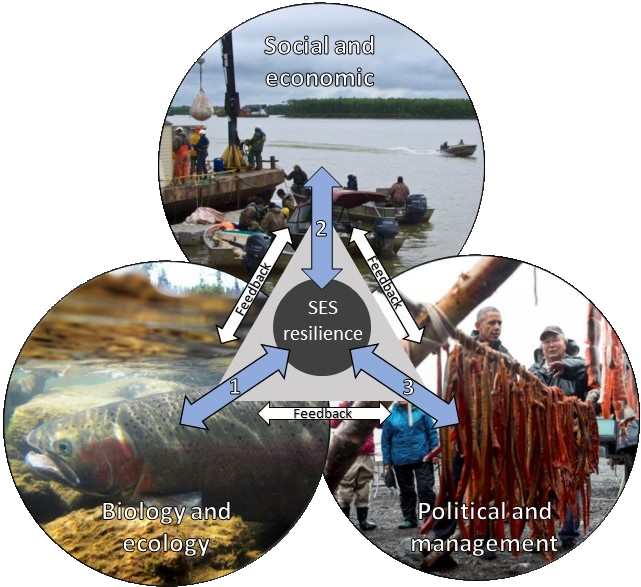
Fishery resilience emerges from behavioural feedbacks between fish, people, and management. Adapted from Ward et al. (2016).
Research themes
- Landscape ecology and life histories of exploited fishesHow growth, maturity, and body size vary across lakes, rivers, and coastlines.
- Risk and resilience in marine and freshwater fisheriesStatus assessments, reference points, and forward simulations of recovery.
- Coupled feedbacks between people and natureHarvesters, managers, and fish as one social-ecological system.
- Trade-offs in conservation and fisheries managementEvidence for decisions that span jurisdictions and governance systems.
- Better fisheries assessment and monitoringModels and survey designs that make the most of limited data.
Projects
Pacific salmon: status, reference points, and rebuilding
Assessing the status of salmon populations and testing which management actions actually rebuild them, with Central Coast and West Coast Nations.
Git Qṃsistá: revitalising herring ecosystems in a warming sea
Weaving Kitasoo Xai'xais knowledge and Western science to restore Pacific herring spawning areas in Kitasu Bay.
Dungeness crab and spot prawn in a changing coast
Movement, habitat use, and the status of marine invertebrate fisheries: the highest-value fisheries in Pacific Canada and the least assessed.
Groundfish life histories and spatial protections
How rockfish life histories shift across space and time, and whether marine protected areas deliver the recoveries they are designed for.
Scale transitions in population dynamics
Local processes are nonlinear and patchy; aggregate dynamics are not their average. We study what happens in between these scales, and what risks arise from ignoring it.
What makes an exploited population resilient?
Building compensation from first principles (life history, plasticity and density dependence) to ask where sustainable harvest actually comes from.
Inclusive risk assessment in an era of co-governance
Reference points encode values, not just biology. We work on assessment frameworks that serve co-governance rather than talking past it.
Life-history diversity in Canada's lake trout
Growth records from 1,100 lake trout across 30 lakes, and a social-ecological halo of depletion around the most accessible ones.